Health Insights 2026: From Research and Innovation to Real-World Impact
What does it take to turn excellent research and promising health innovations into better care, healthier lives and real-world impact?
This question was at the heart of Health Insights 2026. Bringing together researchers, healthcare professionals, companies, innovators and other health ecosystem actors, the two-day event explored the future of healthcare through four interconnected themes: Future Clinical RDI, Personalized Medicine, Prevention and Aging.
Across the programme, one message emerged again and again: innovation creates value only when it reaches people and becomes part of real-world healthcare.
From clinical research to a continuously learning healthcare system
The opening session, Future Clinical RDI – From Collaboration to Innovation, focused on how Finland and the Nordic countries can strengthen the connection between healthcare, research and innovation. The session also served as the closing seminar of the UEF-RDI & PSHVA-RDI ERDF Project, highlighting the work done to strengthen the region’s clinical RDI environment.
In her keynote, Outi Forsström from the Ministry of Social Affairs and Health presented a vision of moving from isolated research projects towards continuously learning health systems. Clinical trials remain essential, but they can increasingly be complemented by real-world data, digital health and AI. The goal is a continuous cycle in which clinical care generates new evidence, evidence improves care, and healthcare continues to learn.
The development of the regional clinical RDI environment was also highlighted by Ville Leinonen from the University of Eastern Finland and the Wellbeing Services County of North Savo. The ambition is practical: to bring healthcare, research and companies closer together, remove barriers to clinical RDI and make available services easier to access.
The importance of implementation was further underlined by Professor Aarno Dietz from the Wellbeing Services County of North Savo and the University of Eastern Finland, who explored why healthcare systems can need innovation urgently while still struggling to implement it.
A clinically validated innovation creates little value if it never becomes part of everyday care. Implementation requires not only scientific evidence, but also regulatory, legal, procurement, IT and organisational expertise. As Dietz put it: “Uncertainty should trigger expertise — not prohibition.”
One concrete example of this journey was presented by Samu Lehtonen, CEO of Marginum. The company’s aspirate tissue monitoring technology originated from a clinical problem and collaboration between neurosurgery, photonics and engineering in Kuopio. The technology analyses tissue removed through a surgical suction instrument and provides immediate feedback to the surgeon. It is an example of how a meaningful clinical question can develop through research and collaboration into a medical technology solution.
Sonja Soininen offered another perspective through the OSMO Teaching Clinic model. By bringing patient care, education, research, development and innovation into the same primary care environment, the model aims to make everyday clinical practice a source of learning and improvement. The longer-term ambition is an Academic Primary Care Ecosystem connecting healthcare services, universities, companies, innovators and real-world data infrastructure.
The global context was brought into the discussion by Tim Sheppard of IQVIA, who highlighted the rapidly changing geography of clinical research. While the Nordic countries have significant strengths – including high-quality healthcare data, national registries, specialist referral centres and strong longitudinal patient follow-up – global competition for clinical research and investment is intensifying.
The session ultimately returned to a fundamental question: how can we accelerate the journey from healthcare research and innovation to real-world clinical impact?
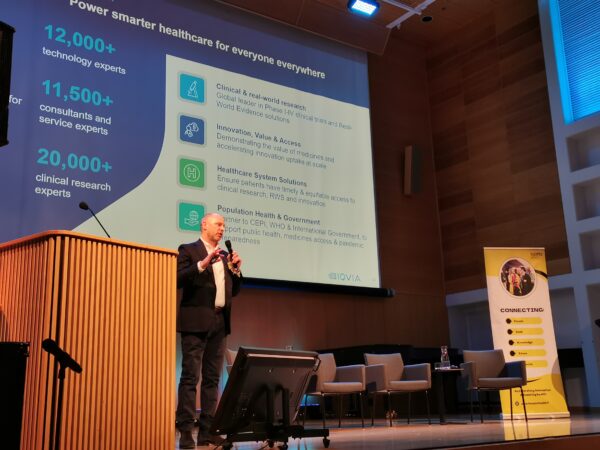
Tim Sheppard, Senior Vice President, IQVIA.
Personalized medicine – from molecules and data to meaningful care
The second major theme explored how healthcare is becoming increasingly personalised – and what this means for research, technology and clinical practice.
Antti Poso from the University of Eastern Finland explored advanced molecular modelling in drug design and the growing role of AI, machine learning and neural networks. His presentation highlighted an important balance: while AI can identify patterns in data, understanding chemistry, physics and molecular mechanisms remains essential in drug discovery. The future is not about AI replacing established scientific approaches, but about combining them.
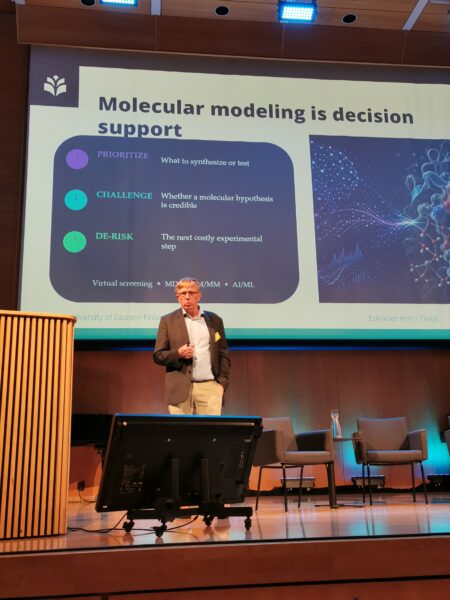
Antti Poso, Professor of Drug Design at the University of Eastern Finland (UEF), School of Pharmacy.
Arto Mannermaa from the University of Eastern Finland focused on personalized cancer medicine. Advances such as PCR, RNA sequencing, liquid biopsies, next-generation sequencing and spatial omics are providing increasingly detailed information about tumours and supporting more individualized treatment decisions. Ultimately, two patients with seemingly the same disease may require very different treatments.
The session also looked at the emerging field of RNA therapeutics. Mikko Turunen from RNatives presented the potential of RNA activation to influence gene transcription inside the cell nucleus, opening possibilities for entirely new types of therapies.
But personalised medicine is not only about increasingly sophisticated technologies. It is also about how data is used.
Anna-Maija Tolppanen from the University of Eastern Finland explored how real-world data can support personalised medicine – while highlighting the challenges involved. High-quality evidence requires sufficient data, appropriate sample sizes, effective analytical methods, external validation, secure data collaboration and, ultimately, solutions that can be implemented in healthcare.
Dr. Chrisna Ravyse of HealthFOX added a distinctly human perspective. More health data does not automatically mean better health. Interoperability, interpretation and context are all needed to turn data into understanding – and understanding into action. Trust, health literacy and everyday behaviour remain just as important.
The discussion also extended to the EU AI Act. Katri Harjuveteläinen of Regulyn challenged the idea that AI regulation should be viewed simply as a compliance burden. If trustworthy AI requirements are built into development from the beginning, compliance can instead support the creation of clinical tools that people can trust, adopt and use.
Prevention – finding the people who benefit most
The Prevention session shifted the focus from treating disease to identifying risk and acting earlier.
Timo Lukkarinen from Duodecim highlighted a fundamental challenge: effective preventive interventions may already exist, but are we reaching the people who would benefit from them most?
Prevention is a chain – screening, prioritising, intervening, maintaining and verifying. If one link is missing, even effective interventions may fail to produce the expected health outcomes. The challenge is therefore not only to develop new preventive solutions, but also to become better at finding, reaching and supporting the people who need them.
Alina Solomon from the University of Eastern Finland presented the journey from the Finnish FINGER study to the global World-Wide FINGERS network. Evidence increasingly shows that multidomain interventions addressing several modifiable risk factors can reduce the risk of cognitive decline. The next challenge is implementation: bringing these approaches into primary care, communities and brain health services, increasingly supported by tools such as blood biomarkers and digital assessments.
Janne Martikainen from the University of Eastern Finland explored the economic perspective, examining the cost-effectiveness of metabolomics-based health checks for identifying future cardiometabolic disease risk. Risk stratification could help direct preventive interventions and healthcare resources towards those most likely to benefit.
Antti Kangas, Co-founder and CTO of Nightingale Health, addressed the detection challenge from another angle. Prevention depends on finding people at risk while they are still healthy – before they enter the healthcare system as patients. Risk detection from a single blood sample offers one possible route to identifying elevated risks at scale.
Meanwhile, Jussi Hahtela, CEO of Biohit, highlighted the importance of using scarce healthcare resources intelligently. In diagnostics, better risk identification can help ensure that patients who urgently need further examinations receive them, while avoiding unnecessary procedures for those at lower risk. But technology alone is not enough: implementation, agile pilots and validation are essential.
The panel discussion brought the different perspectives together around a powerful idea: prevention requires investment today, while many of its benefits only become visible years later. Seeing prevention as an investment rather than simply a cost may be one of the key shifts needed to move healthcare upstream.
Aging – treating the person, not just the disease
The final theme of Health Insights 2026 focused on aging and the growing need to rethink how healthcare responds to older people.
Timo Nykopp from FICAN and the University of Eastern Finland highlighted the importance of individualising cancer diagnostics and treatment for older patients. Chronological age alone should not determine treatment intensity. Functional capacity, frailty, comorbidities and patient preferences all need to be considered when deciding whether active treatment is likely to benefit an individual.
Timo Nykopp, MD, Ph.D, FEBU, Associate Professor of Urology (tenure track), Institute of Clinical Medicine, University of Eastern Finland, Chief Physician, Finnish Cancer Center FICAN.
Erkki Soini of ESiOR brought a health economics perspective to Alzheimer’s disease, highlighting the importance of looking beyond direct healthcare expenditure. The burden also includes the considerable resources and time required from family members and informal caregivers. Understanding the full economic burden is essential when assessing the value of prevention, earlier diagnosis, treatment and care.
Eino Solje from the University of Eastern Finland and the UEF Brain Research Unit demonstrated the strengths of Kuopio’s clinical neuroresearch environment. More than 30 years of clinical trial experience, deeply characterised patient cohorts, biomarkers, biobanks, genomics, Finnish real-world data and international research networks come together in a closely connected ecosystem.
The ambition is to move “from a trial site to an implementation platform” – creating pathways from clinical questions to research, validation and ultimately implementation in healthcare.
An especially fascinating example came from Professor Tarja Malm of the A.I. Virtanen Institute. Her research uses tiny pieces of brain tissue obtained during surgery for normal pressure hydrocephalus. Rather than being discarded, this living tissue can provide a rare opportunity to study early disease mechanisms and Alzheimer’s-related pathology.
By combining tissue samples with electrophysiology, spatial transcriptomics, electron microscopy, genetics and long-term patient data, researchers can investigate what happens to neurons and brain networks at early stages of disease. It is a striking example of how something that might otherwise be considered waste can become a valuable source of new knowledge.
Mikko Tiihonen from Forsante addressed another challenge increasingly relevant to aging populations: multimorbidity. Clinical knowledge and decision-support systems are often organised around individual diseases, while real patients may live with several conditions whose treatments and recommendations interact.
The challenge is therefore not simply to provide clinicians with more information, but to integrate that information into one coherent clinical plan. In Tiihonen’s words, the 21st century must learn to “integrate the patient back together.”
The Aging session also raised a broader question: does chronological age actually tell us what a person needs from healthcare?
The closing panel suggested that it may sometimes tell us surprisingly little. People of the same age can differ greatly in their health, functional capacity, diseases and individual needs. A more meaningful approach is to ask what a person’s actual health status, risks and goals are and how healthcare can support a healthy and meaningful life.
From excellent science to meaningful impact
Across two days and four themes, Health Insights 2026 demonstrated how closely connected the future of healthcare is to collaboration.
Whether the topic was clinical RDI, molecular modelling, RNA therapeutics, real-world data, AI, prevention, nutrition, cancer, dementia or multimorbidity, the same challenge kept returning: how do we turn knowledge into action?
For Kuopio and the wider Eastern Finland health ecosystem, this is also an opportunity.
The region brings together clinical expertise, research, healthcare data, universities, companies, technology and an increasingly connected innovation ecosystem. As several examples presented at Health Insights showed, meaningful innovation can begin with a clinical question, develop through cross-disciplinary collaboration and ultimately reach patients as a new technology, treatment, diagnostic method or way of organising care.
At the same time, one message from the discussions was clear. We should be proud of the world-class expertise we have here in Kuopio and be much louder about it. The research, clinical knowledge and innovations emerging from the region deserve to be seen, heard and recognised both nationally and internationally. Stronger visibility can also help connect local expertise with new partners, investment and opportunities for collaboration.
Perhaps the most fitting conclusion to the two days came from the discussion on clinical innovation: research and technology alone are not enough. Innovation creates value when it reaches the patient.
That is the journey Health Insights 2026 explored – from research and collaboration to innovation, implementation and, ultimately, real-world impact. And it is a journey that Kuopio has a strong foundation to lead.