Presenting Kuopio Health members: Rayca Precision Ltd
Building a collective memory for drug discovery – Meet Rayca Precision
Artificial intelligence is advancing rapidly. New computational molecular models can predict protein structures, generate biomolecules, and help researchers explore biological mechanisms in ways that would have been difficult to imagine only a few years ago. Yet developing a new medicine remains a long, expensive, and failure-prone process.
For Rayca Precision, this apparent contradiction points to a fundamental challenge in pharmaceutical R&D: having better AI models is not enough anymore. The knowledge generated across years of research – including what did not work – also needs to be connected, retained, and used to guide future decisions.
This is where Rayca Precision sees an opportunity to rethink the way computational drug discovery is done.
“Drug development needs a memory of what failed, and why. That is what we are building,” says Pouya Behrouzi, Co-founder and CEO of Rayca Precision.
When failure becomes valuable knowledge
Drug discovery generates enormous amounts of information. Researchers learn about biological targets, molecular structures, safety, developability, manufacturing, delivery, and countless other factors that determine whether a promising molecule might eventually become a medicine. They also learn from failure.
A candidate may perform well during the early discovery phase but encounter problems later in development. A molecule may have structural characteristics that make it difficult to manufacture or formulate, or a biological hypothesis may ultimately prove unsuccessful.
According to Behrouzi, the problem is not simply that failures occur. The question is what happens to everything that was learned from them.
Within large R&D organisations, knowledge can become fragmented across projects, teams, departments and different computational systems. Rayca’s vision is to turn these accumulated lessons into what the company calls institutional molecular intelligence – knowledge that can continue to inform molecular design long after an individual research programme has ended.
“Failed therapeutic assets generate a tremendous amount of valuable molecular data. Those failure modes can become molecular-level intelligence and guiding principles for designing the next therapeutic molecules against those failure modes that have already been seen before in development life-cycle.”
Instead of repeatedly starting from scratch, future programmes could benefit from the knowledge accumulated through previous successes and failures. In other words, programmes may end, but the knowledge they create does not have to disappear.
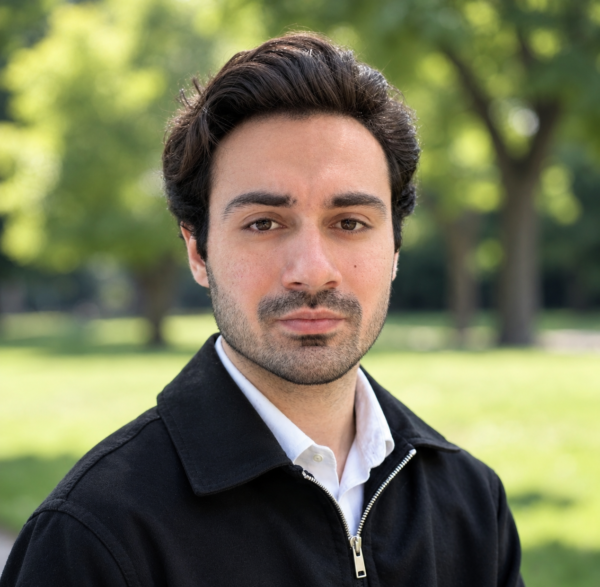
Pouya Behrouzi, founding member and CEO of Rayca Precision.
More than another AI model
The distinction is important because Rayca is not trying to win by building yet another standalone AI model for designing molecules.
Instead, the company is building molecular intelligence for pharmaceutical R&D: a platform that connects AI models, physics-based simulation, experiments and an organisation’s own accumulated data and knowledge.
Modern drug discovery already has access to an expanding range of specialised computational tools. Some predict protein structures or molecular behaviour, while others generate potential small molecules, peptides, antibodies, nanobodies, inhibitors or degraders. Rayca’s platform brings hundreds of these models and simulation engines together, ready to run, and connects them with the scientific context and knowledge that already exists within an organisation.
“We are not trying to win by building one more model. We build the molecular intelligence that connects models, simulation, experiments and a company’s own evidence, so every programme learns from the ones before it”, Behrouzi continues.
The platform will be deployed within the pharmaceutical company’s own secured research environment, so proprietary evidence, models and programme knowledge remain under its control rather than being transferred outside the organisation. For pharmaceutical companies, where research data is closely connected to intellectual property, this ability to maintain control over data is particularly important.
Rayca describes the platform as the intelligence that connects computational methods, research teams and the knowledge accumulated across therapeutic programmes.
And that connection and integration of bio AI model inferences and self-improving molecular intelligence and memory system is ultimately what differentiates the company’s approach.
From a biological question to a better molecule
So what does this look like in practice? A drug discovery programme may begin with a hypothesis: researchers have identified a protein or biological pathway associated with a disease and want to understand whether it could be targeted therapeutically. The first step is understanding the biology and the structure and behaviour of the target.
Researchers may already have experimental structural data. When they do not, computational models can help predict how a protein is structured. Physics-based simulations can then be used to explore how the protein moves and changes shape over time – potentially revealing opportunities for therapeutic intervention that would otherwise be difficult to detect.
From there, different computational models can generate possible therapeutic designs, including small molecules, peptides, antibodies, nanobodies, inhibitors and degraders.
Instead of stopping at the question of whether a molecule can bind to its intended target, the process can also examine potential risks that may become important later: toxicity, immunogenicity, stability, formulation, delivery and manufacturability, the developability liabilities that often end programmes late.
The aim is to identify some of these potential liabilities before significant time and resources have been invested in laboratory experiments and later stages of development. But computational prediction is only part of the process.
Laboratory results are fed back into the design cycle so that what researchers learn experimentally can inform the next computational iteration. Rayca refers to this as a lab-in-the-loop approach: design, test, learn and redesign. This creates a continuous learning cycle between computational modelling and experimental science.
AI can automate the work, but scientists steer the science
As AI becomes increasingly capable, an obvious question emerges: what happens to the human scientist? For Rayca, the answer is clear. Automation does not mean handing scientific decision-making over to AI. AI agents can already automate many computational tasks. Behrouzi gives the example of setting up complex molecular dynamics simulations: work that might previously have required weeks of manual trial and error can increasingly be accelerated through specialised AI agents running on GPU and high-performance computing infrastructure.
But increased automation also creates an enormous number of possible directions to explore. That makes scientific judgement even more important.
“Where to explore and where to steer the AI agents still needs to be directed by a human scientist”, Behrouzi says.
Rayca’s approach therefore keeps scientists in the loop through decision gates. AI agents may perform analyses, build workflows, and present results, but scientists can review the methodology and evidence before deciding whether the process should continue.
This is also connected to another challenge surrounding AI in science: trust. Some researchers remain understandably cautious about AI-generated molecular designs if they cannot see why a particular structure was proposed. Behrouzi believes that moving from black-box systems towards transparent, traceable reasoning will therefore be essential.
Researchers need to be able to trace where a design came from, which evidence supports it, which methods produced it, what modifications were made, and what reasoning contributed to the result. The goal is not to replace scientific expertise, but to give scientists more powerful ways to use it.
Tackling the challenges traditional methods struggle with
Rayca sees particular potential where conventional drug discovery approaches are struggling. This might mean a difficult biological target, a therapeutic pipeline that has stalled, or a programme experiencing problems during preclinical or clinical development.
Rather than treating the information generated by these difficulties simply as evidence of failure, Rayca wants to help drug developers ask a different question: What can everything we have already learned tell us about how to move forward? The company’s own therapeutic collaborations also illustrate how computational and experimental expertise can complement each other.
Rayca does not run its own wet laboratory. Instead, partner laboratories are connected directly into the design cycle, and Rayca co-develops therapeutic programmes with organisations that bring medicinal chemistry, protein engineering, biological testing and translational research capabilities.
In one collaboration focusing on HPV-driven cancers, for example, Rayca works together with the University of Arkansas for Medical Sciences and the University of New Mexico. Different partners contribute complementary expertise ranging from AI-based molecular design and physics-based simulation to medicinal chemistry and disease-relevant biological testing.
Rayca recently announced a strategic partnership with the Dutch TechBio company QurieGen, connecting QurieGen’s time-resolved single-cell multi-omics with Rayca’s molecular design, so that biological insight guides design and cellular testing shows whether a molecule produces the intended effect. With Data Powered Therapeutics, Rayca pairs computational design with automated, high-throughput protein characterisation to co-develop nanobody therapeutics.
For Rayca, this is what successful collaboration looks like: combining capabilities that no single organisation necessarily needs to possess alone.
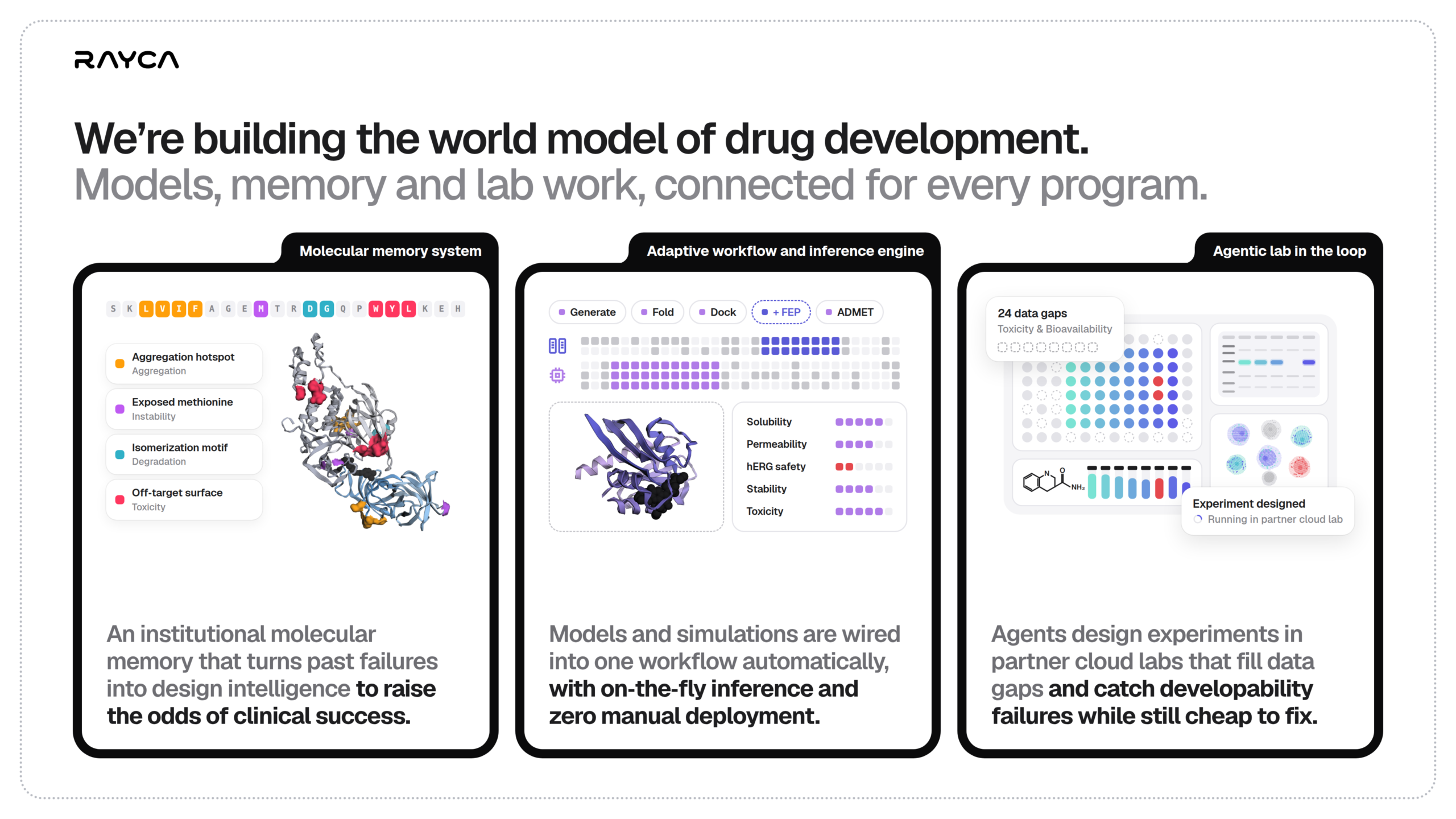
Rayca Precision’s platform combines molecular knowledge, artificial intelligence models, computational simulations, and experimental research into a unified drug development process.
Finland offers innovation, expertise and openness to collaboration
Although Rayca operates internationally, Finland has an important role in the company’s development. Behrouzi describes the Finnish pharmaceutical R&D market as relatively small, but the level of innovation as outstanding. He points in particular to the expertise found in Kuopio.
“The research in Kuopio is outstanding. The level of expertise in computer-aided drug design is really at the edge of science.”
For Rayca, Finland provides an environment where the company can explore how its platform can integrate into research workflows both in academia and industry. Behrouzi also values another characteristic: openness.
“It is very easy to talk to people here. They are open to collaboration and to making introductions to other ecosystem and industry players.”
Through the Kuopio Health network and the wider Finnish life sciences ecosystem, Rayca is particularly interested in connecting with computational and machine learning teams, pharmaceutical companies, biotech teams with a difficult molecular programme, translational researchers and early-stage therapeutic companies. The latter can be especially interesting.
An early-stage company may have deep biological expertise and strong evidence behind a promising therapeutic target, but relatively limited computational drug design capabilities. Bringing computational modelling into the programme early could help identify risks before they become much more expensive problems later in development. For Rayca, these are precisely the kinds of connections that can lead to meaningful partnerships. Rayca typically starts with one difficult molecular programme and returns what the evidence implies for the next decision.
Towards operating intelligence for molecular R&D
Where could all of this lead? Behrouzi’s ambition for the next five years is that he would like to see Rayca become one of the standard approaches used by small, mid-sized and eventually large pharmaceutical companies when developing therapeutic pipelines. The longer-term vision goes beyond automating individual computational tasks.
Rayca wants to help break down the silos that exist between departments, computational tools and research programmes and turn fragmented information into institutional molecular intelligence that can grow over time.
It could ultimately enable knowledge to move not only between projects and departments, but also between collaborating organisations when they choose to share it.
For Behrouzi, some of the most exciting developments are happening simultaneously on several fronts. AI reasoning models are becoming increasingly capable of solving complex problems and coordinating specialised agents. At the same time, models for protein and chemistry design continue to improve, and computing power makes increasingly demanding simulations possible.
But Rayca’s core idea is that the future of AI-driven drug discovery may not depend only on creating ever more powerful models. It may also depend on making sure that the lessons learned today are still available to the scientists designing tomorrow’s medicines.