Presenting Kuopio Health members: Surgerix Oy
Surgerix – Towards smoother and safer surgery
Microsurgery requires extreme precision and concentration. At the same time, the surgeon must maintain overall situational awareness in an environment where the field of view is limited and work is often performed through highly magnified imagery. Originating from Kuopio, Surgerix Oy is developing a software solution designed to address this core challenge.
The company’s technology is based on research conducted at the HUMEA Laboratory of the University of Eastern Finland and the Microsurgery Center of Eastern Finland at Kuopio University Hospital (KYS). The development stems in particular from the observation that surgeons constantly have to balance precision with maintaining the overall context.
“When neurosurgeons were asked what the biggest challenge in microsurgery is, the answer was loss of context. That’s where our solution began,” says Surgerix CEO and co-founder Mikko Pitkänen.
Surgerix’s development is guided by a clear goal: to improve the surgeon’s workflow and, consequently, patient safety.
“The aim is to make the surgeon’s work easier, improve performance, and reduce risks. Ultimately, it’s about helping the surgeon see better, and that can have a significant impact on the entire procedure.”
From research environment to practical application
Surgerix’s development began as a research project exploring the use of computer vision in surgical work. Following a Proof of Concept phase and a Research-to-Business project, the technology has progressed toward a commercial product. Close collaboration with the clinical environment has played a key role throughout the process.
“It’s a major advantage that the solution can be developed directly in the environment where it is used. The Microsurgery Center provides exceptionally strong conditions for this,” Pitkänen notes.
The company continues to operate in close connection with research and hospital environments, enabling continuous testing and development based on real clinical needs. The Microsurgery Center also welcomes new startups to test, develop, and pilot their solutions.
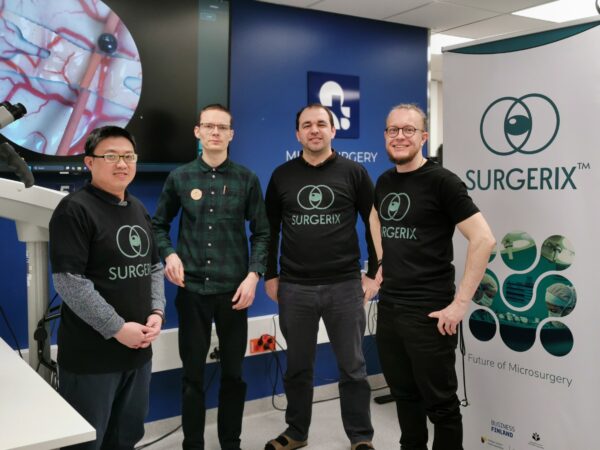
From left, trainee Khoi Nguyen, Paavo Vartiainen, Zeynel Karadis and Mikko Pitkänen.
Two core functionalities improve visibility
Surgerix’s solution focuses on visibility challenges in microsurgery through two key functionalities. The first is the so-called Context Preserving Zoom, which combines a highly zoomed-in view with the broader context in a single image.
“Typically, the surgeon has to switch views or monitor two separate displays. In our solution, the wider context and the precise working area are visible simultaneously,” Pitkänen explains.
The second key feature addresses visual obstructions caused by surgical instruments.
“If an instrument blocks the view, it makes the work more difficult. The goal is to improve visibility in situations where precision is critical.”
Simplicity has been a guiding principle in the design of the solution.
“Our starting point has been to create practical, easy-to-use functionalities without unnecessary complexity.”
Real-time support sets the solution apart
Various planning and navigation tools have long been developed in the field of surgical technology. However, Surgerix focuses specifically on providing real-time support during surgery.
“So far, there are only a limited number of solutions that deliver tangible benefits directly during an operation,” Pitkänen explains.
According to the company, this is a key differentiator and has been clearly recognized as valuable.
Early results indicate significant benefits
The impact of the technology has been evaluated in preliminary tests, including analysis of procedure duration.
“Surgery time was compared with and without the application. Performance was approximately 40 % faster using our solution.”
Although clinical validation is still ongoing, the results suggest that the solution may significantly impact both procedure duration and patient safety. Shorter operating times mean that surgical wounds are open for less time, reducing the risk of infection. At the same time, improved visibility supports the surgeon during critical phases and may help reduce errors and complications.
“From the patient’s perspective, the key is that the procedure can be performed faster and in a more controlled manner. Every avoided complication is significant.”
Estimates suggest that similar solutions could have broad applicability.
“We’re talking about tens of millions of surgeries annually where this type of functionality could be beneficial.”
International development and piloting underway
Currently, Surgerix is focusing on piloting its solution in research and training settings. The company is actively seeking partners both in Finland and internationally.
“We are testing the solution in different environments and collecting feedback from surgeons. There has been strong interest across multiple countries.”
The team operates in a distributed manner and includes experts from several countries. Internationality is seen as essential for developing a global solution, both from technological and clinical perspectives. In addition to CEO Mikko Pitkänen, the founding team includes Paavo Vartiainen (CTO, Research & Development), Zeynel Karadis (Software Development), Gaukhar Mukash (MD, Clinical Validation), and Dr. Ahmed Hussein, a neurosurgeon who serves as a medical advisor and expert.
“When developing a global solution, having an international team is a major advantage,” Pitkänen says.
In April 2026, Surgerix was selected to participate in the prestigious MedTech Innovator Radar Forum, with only about 10 % of over 1,800 applicants accepted. The company engaged in discussions with investors, strategic partners, and key players in the international medtech ecosystem. The event provided an opportunity to showcase its solution to a global audience, build new partnerships, and strengthen connections with industry stakeholders.
“Participating in events is an important way for us to present our solution and be part of key industry discussions.”
Next steps: validation and market entry
Surgerix is currently preparing for clinical studies and regulatory processes, aiming to achieve CE marking in Europe and FDA approval in the United States.
“Once we have sufficient evidence of the solution’s effectiveness, the next step is market entry.”
As a software-based solution, the company sees collaboration with device manufacturers as essential for scaling.
“Integration with existing devices enables broader adoption.”
Ecosystems and networks supporting growth
Surgerix operates actively within both Finnish and international health and medtech ecosystems. The company participates in several accelerators and networks that support its growth. Kuopio Health has been familiar to the Surgerix team for years.
“The importance of networks is especially highlighted in the early stages of a company: they provide not only expertise and new contacts, but also much-needed peer support for the everyday life of an entrepreneur, which can sometimes be lonely. Joint participation in events and trade fairs offers valuable opportunities to showcase solutions internationally. At the same time, various funding sources and internationalization support form a key foundation for company growth and development,” Pitkänen summarizes.