R&D actors in spotlight – Hearing Valley
What’s happening in Hearing Valley?
What does the world sound like when a hearing aid doesn’t work optimally? What if you’re surrounded by speech, traffic noise, and background sounds all at once? And what happens when hearing loss begins to limit social interaction?
Globally, more than 480 million people live with disabling hearing loss requiring rehabilitation, and the number is expected to rise to over 900 million by 2050 due to population ageing (WHO). Untreated hearing loss already costs society an estimated USD 950 billion annually, largely due to social isolation and mental health impacts. It is also the single largest modifiable risk factor for dementia.
Despite the growing prevalence of hearing loss in Finland, expertise in audiology and audio signal processing – as well as company-driven product development – remains limited. At the same time, population ageing and the increasing use of headphones are driving demand for advanced technological solutions in hearing rehabilitation and signal processing more broadly.
Without innovations, the shortage of healthcare resources will deepen, and access to services – particularly remote services and those outside urban centres – will decline. This creates a significant business opportunity and makes the topic highly relevant also for actors whose expertise has so far focused on other biosignals. In Northern Savo, there is strong interdisciplinary potential that has not yet been fully leveraged to meet this growing global demand.
A unique RDI environment for hearing research
Hearing Valley is an RDI project initiated by the University of Eastern Finland and co-funded by the EU. Its goal is to build a unique hearing research laboratory at the Savilahti campus and to develop a closely connected innovation ecosystem around hearing healthcare.
The aim is to improve hearing services, develop new technological solutions, and ultimately support people’s everyday lives and quality of life.
The project is part of the Towards Better Hearing research group, which has been actively working at Kuopio University Hospital since 2008. The group consists of a multidisciplinary team of medical professionals and experts in engineering and physics, collaborating internationally with researchers and companies.
Bringing real life into the laboratory
The starting point for Hearing Valley is a well-known limitation in hearing research: traditional soundproof laboratory environments do not reflect real-life listening situations.
“In realistic sound environments like the ones we can create here, we can gain more accurate information about hearing. In the future, rehabilitation can be better tailored based on this. Often, the first hearing challenges appear specifically in noisy environments,” explains Project Manager Ville Saari.
Hearing Valley addresses this gap by bringing research, clinical work, and industry collaboration under one roof. The Savilahti campus provides a natural environment where disciplines and stakeholders meet in everyday work.
At the heart of the project is a hearing laboratory designed to simulate real-world sound environments – such as streets, restaurants, and other everyday soundscapes where hearing truly matters.
“This opens entirely new possibilities for both research and product development. Hearing aids, diagnostic methods, and digital solutions can be evaluated in realistic use scenarios, with a strong user-centered approach and individual hearing challenges in mind,” continues Project Coordinator Jaana Hyytiäinen.
The laboratory serves a wide range of users: researchers, clinical professionals, and companies developing hearing-related technologies. The goal is not only to test existing solutions, but also to create entirely new ones.
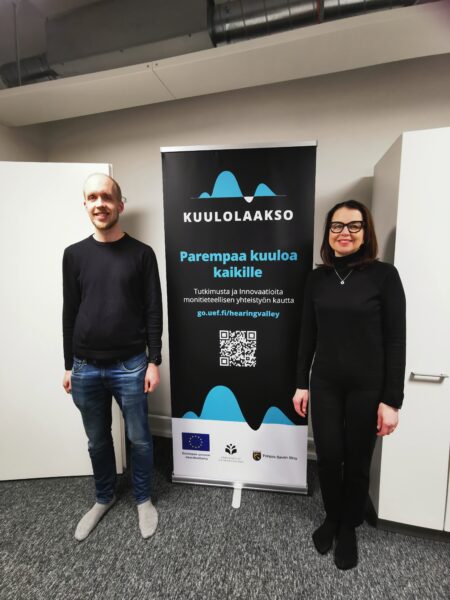
Hearing Valley project director Ville Saari and project coordinator Jaana Hyytiäinen.
Building something new together
The Hearing Valley project officially started in early 2025. The laboratory design was completed in April, construction began in July, and the facility is now largely equipped.
The lab will also include EEG equipment, enabling the measurement of brain activity in different sound environments.
“This allows us to study not only whether a sound is heard, but also how the brain responds to it – for example, to direction, intensity, and variation. Even if hearing appears relatively normal in traditional tests, people may still experience difficulties. EEG measurements can provide entirely new insights into this,” Saari explains.
The project is run by Saari together with Project Coordinator Hyytiäinen and Project Assistant Juulia Hassinen. Workshops play a key role in the project, enabling co-creation with companies and stakeholders.
“Workshops are extremely important to us. They are not just about presenting ready-made solutions – they are about building together what Hearing Valley will become in the future,” says Hyytiäinen.
The university also plays a crucial role in educating future professionals, including medical doctors and engineers. Students are actively involved in the lab’s activities.
Currently, a student project is underway in collaboration with the Department of Technical Physics. The project includes acoustic modelling, simulations, and experiments related to spatial hearing, as well as a video project in collaboration with the City of Iisalmi.
From research to real-world innovation
The Wellbeing Services County of North Savo plays an important role by enabling access to research participants.
Long-term research led by Professor Aarno Dietz and his team has resulted in the TrueHear innovation, which allows individuals to measure their hearing in realistic everyday situations – such as assessing how well they can follow a conversation in a noisy café. Dietz received the Nordic Medical Innovation Award in January 2026 for his work.
Pilot studies are already underway in the laboratory, helping to test the facilities and identify areas for further development.
At the same time, the project is mapping future competence needs in the region – identifying what kind of expertise companies require and how education can support this. Based on these insights, targeted training will be developed, from individual courses to potentially full degree programmes.
Data, collaboration and future potential
A key part of the development is collaboration with the Biobank of Eastern Finland. The goal is to combine biological samples with hearing-related research data to create a comprehensive, systematically collected data resource.
Currently, hearing data from hospitals is stored in separate systems, but in the future, biobank integration could enable controlled and permission-based access for researchers and companies. This would open up entirely new possibilities for data-driven innovation.
Companies actively involved
“Collaboration with companies is a cornerstone of Hearing Valley. The project offers particular value for companies developing hearing technologies, digital solutions, or audio-related applications,” Saari and Hyytiäinen emphasize.
One example is Genelec, a globally known manufacturer of audio equipment. Combining sound and health technology opens up new opportunities in both diagnostics and user experience.
“Genelec’s expertise in sound can bring new dimensions to hearing diagnostics,” Hyytiäinen notes.
CEO Siamäk Naghian sees Hearing Valley as an example of how companies can take societal responsibility while also creating new business opportunities.
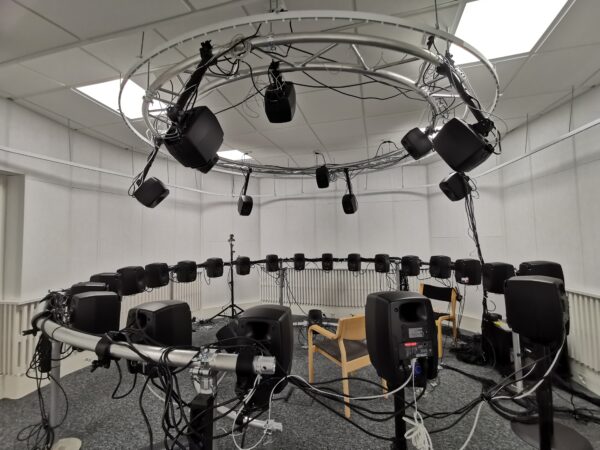
The research room of the Hearing Valley is equipped with speakers arranged in a circle.
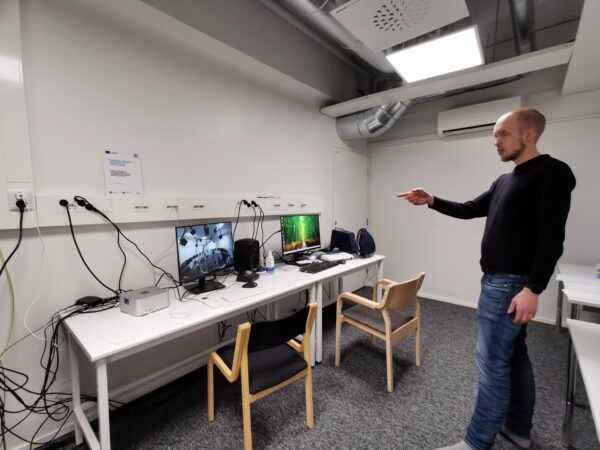
In the laboratory monitoring room, you can follow the research taking place in the research room.
Long-term impact
Hearing Valley is funded by the European Regional Development Fund (ERDF) and will run until autumn 2026. The funding enables not just individual experiments, but the creation of permanent infrastructure and operating models.
The goal is for Hearing Valley to continue evolving beyond the project period as part of the regional and university-based hearing ecosystem.
Its long-term impact extends from individuals to the entire health ecosystem. Early detection and prevention can reduce the broader effects of hearing loss, such as social isolation and cognitive decline.
At the same time, the project strengthens the position of Kuopio and the Savilahti area as an internationally attractive hub for hearing healthcare and health technology. Kuopio Health plays an important role as a facilitator and bridge-builder between stakeholders.
Hearing Valley is still evolving, but its direction is clear: when research, clinical work, and industry truly come together, meaningful solutions are created – not only in laboratories, but in people’s everyday lives.
“The real moment of success is when we see that the solutions we develop genuinely improve someone’s daily life,” Hyytiäinen concludes.
Contact:
Aarno Dietz, Professor, Institute of Clinical Medicine, School of Medicine, Faculty of Health Sciences, aarno.dietz@uef.fi
Ville Saari, Project Leader, Institute of Clinical Medicine, School of Medicine, Faculty of Health Sciences, ville.saari@uef.fi |+358 50 467 7196
Jaana Hyytiäinen, Project Coordinator, Institute of Clinical Medicine, School of Medicine, Faculty of Health Sciences, jaana.hyytiainen@uef.fi |+358 50 476 7827
Juulia Hassinen, Project Assistant, Institute of Clinical Medicine, School of Medicine, Faculty of Health Sciences, juulia.hassinen@uef.fi |+358 50 479 7374
The Hearing Valley project is funded by the European Regional Development Fund (ERDF) and will run from October 2024 to September 2026, in close collaboration with Kuopio Health and regional companies. The Hearing Valley project is part of the University of Eastern Finland’s hearing care innovation ecosystem and aims to improve hearing care services with new technological solutions. The project will develop new diagnostic methods and hearing aids based on the latest research and technology to support individualized care and improve patients’ quality of life.