R&D actors in spotlight – National Virus Vector Laboratory
National Virus Vector Laboratory – a global pioneer in gene therapy in Kuopio
Kuopio Health’s RDI actors in spotlight article series presents organisations involved in research, development and innovation in the Kuopio region. This article concerns the National Virus Vector Laboratory which operates at the A.I. Virtanen Institute, University of Eastern Finland. The laboratory has emerged as a major player in the development of gene therapy in Finland and worldwide.
The National Virus Vector Laboratory at the A.I. Virtanen Institute produces quality-assured adenoviral, lentiviral, baculoviral, and AAV viral vectors not only on a laboratory scale, but also at a larger scale, utilising two GMP-level and three BSL2/BSL3-level laboratories equipped with bioreactors (10–100 L), vector concentration equipment, cell banks, and the measurement devices required for characterisation.
NVVL is part of the EU’s ATRIS ESFRI research infrastructure, and it has produced GMP-level vectors for phase I-II clinical trials for European multicentre studies. Over the past decade, the laboratory has also produced clinical-grade viral vectors for preclinical purposes for more than a hundred clients in Finland, the EU and outside the EU.
The laboratory’s services are aimed at research communities and biotechnology companies in Finland, the EU and around the world. In recent years, the viral vectors produced or developed by the laboratory have been used in not only preclinical trials but also several international patient studies that have involved developing gene therapy for the treatment of cardiovascular diseases and cancers. The laboratory produces adenoviral, lentiviral and AAV viral vectors, which are also used, for example, for RNA and cell therapy as well as protein production. An important partner to the laboratory on the university campus is the research-based virus and gene therapy drug manufacturer FinVector Oy.
Long history and world-class competence
The National Virus Vector Laboratory is a pioneer in gene transfer technology and gene therapy with roots dating back to the early 1990s.
“We’ve been industry pioneers ever since the establishment of our laboratory. Research in gene therapy was launched in Kuopio before there was any official infrastructure”, says Professor Seppo Ylä-Herttuala, MD, PhD.
National and international influence
The National Virus Vector Laboratory operates as a part of Biocenter Finland and belongs to the Viral Gene Transfer and Cell Therapy Technology Platform networks which brings together all major operators in viral vectors and gene transfer technology in Finland. At the international level, the laboratory is a part of the EATRIS infrastructure (European Infrastructure for Translational Medicine) and has participated in numerous EU projects.
”Our laboratory has already delivered viral vectors to over one hundred sites around the world, mostly research institutes and biotech companies, explains Staff Scientist Petri Mäkinen, PhD.
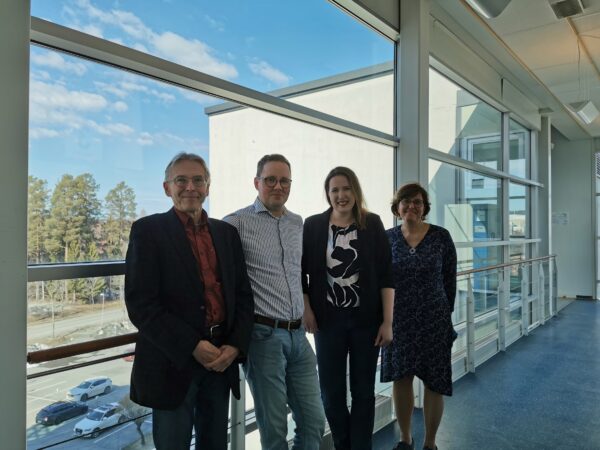
Image: personnel in charge of the National Virus Vector Laboratory. From the left: Seppo Ylä-Herttuala, Petri Mäkinen, Johanna Laakkonen and Nihay Laham-Karam.
Viral vectors – drugs and tools for research
Viral vectors are used to transfer genetic material into cells in the body. They may have a short- or long-term effect and target various tissues. As a result, the selected vector type is always determined based on the goal set for the study or treatment.
“For example, adenoviruses are effective in short-term therapies, such as cancer treatment, whereas lentiviral vectors are suitable for the long-term treatment of hereditary diseases”, Mäkinen says.
Research Director Johanna Laakkonen, PhD, explains that viral vectors do not exist for drug development only, but they also serve as valuable tools for gene expression in basic research.
The services of the viral vector laboratory are open to an extensive user group, including both academic researchers and biotech companies. Potential user groups include especially gene researchers and molecular biologists who examine the function of individual genes or need tools for the regulation of gene expression. The laboratory’s specialists can tailor a viral vector based on the gene selected by the user and produce a ready-made vector for research use.
The laboratory plays a key role in supporting research by offering ready-made control vectors. These are particularly necessary in situations where researchers are developing their own applications or studies related to genes but need reliable control alternatives alongside these.
“In practice, we offer off-the-shelf – or, actually, freezer – control vectors. We often ship them to Europe, and the recipients are mainly academic research institutes but also include companies”, says Research Director Nihay Laham-Karam, PhD.
Although the actual research subject, such as a specific gene, is typically developed by the researcher, producing controls may be a labour-intensive and time-consuming process. “This is often work that requires a lot of resources. As a result, we’ve noticed there’s a constant demand for control vectors”, Laham-Karam says.
Viral vectors are also extensively used in basic research outside drug development. For example, they can be used to quickly express the desired protein in a cell culture or inhibit a specific gene. This makes viral vectors an effective and flexible tool for examining gene function – regardless of whether the objective is to develop a new treatment or increase scientific knowledge.
Latest technology and unique competence
“In addition to viral vectors, we’ve also recently established a nanoparticle laboratory, which enables us to produce not only viral but also nanoparticle-based gene therapy drugs”, Mäkinen continues.
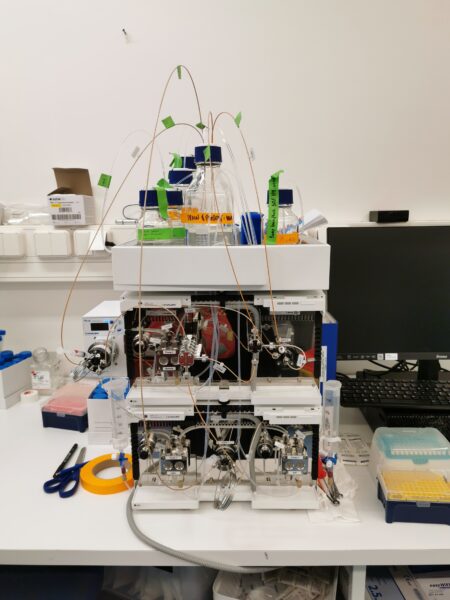
Nanoparticle manufacturing equipment
NVVL also serves as an expert in the design of clean rooms and biosafety infrastructures, including the international GeneT project that collaborates with Europe’s leading research centres in gene therapy. This international project seeks to improve the efficiency of the manufacturing of gene therapy drugs. The other project partners are from Portugal and the United Kingdom. The project was launched in 2023 and will be completed in 2029.
“We also have other academic research and cooperation projects as well as business partners. And then we have projects that seek to find commercial applications for these gene therapy drugs”, Ylä-Herttuala continues.
Research to benefit patients
The products developed through research conducted at the laboratory have been particularly used in the treatment of challenging chronic conditions and rare hereditary diseases. The developed gene therapy drugs are used to treat diseases such as bladder cancer, brain tumours and difficult cases of coronary artery disease. NVVL has also conducted research in rarer conditions, such as familial hypercholesterolemia, a disorder characterised by high cholesterol levels caused by a gene mutation. The development of gene therapy drugs is a long-term process; the clinical trial phase alone may take over 10 years before the product will be ready for assessment by regulatory authorities and possible introduction.
“The amount of gene therapy drugs available in the market is growing rapidly. If we look back, say, 10 years, there were maybe five approved drugs in the market. Today, their number is approaching 30 to 40. And if we think about the situation 15 years into the future, their number is expected to reach up to 400. So there is room for growth in the market. But, of course, we hope they will begin to gain a permanent foothold in the pharmaceutical market. That way, you’ll get research funding and will be able to introduce innovations and new gene therapy drugs to the market. So far, research is slow and expensive, but the way forward is clear – this is future medicine”, the team emphasises.
The specialists employed by the laboratory work in various areas of responsibility in viral vectors: Laakkonen is responsible for the adenoviral vectors, Mäkinen serves in the role of Staff Scientist and is responsible for lentiviral vectors and AAV viral vectors, and Laham-Karam is responsible for bioreactor production. The team is supported by a group of highly experienced researchers and technical experts. Laakkonen also has a dedicated research group in vascular biology that uses vectors.
“You learn new things every day in this work. It’s extremely motivating to get to be involved in developing solutions for the treatment of severe illnesses and be at the forefront of research”, the team describes.
The power of Kuopio campus
One of the laboratory’s strengths is its location in the Kuopio campus, where it is close to the university and the hospital as well as companies operating in the sector such as FinVector and Rokote Laboratories.
“Being within walking distance and the fact that the companies and the Kuopio University Hospital are located nearby enable cooperation at the everyday level and lower the threshold for sharing competence”, Ylä-Herttuala says.
“You could say that globally speaking, the whole Virus Vector Laboratory is a highly significant cluster that is without equal. Having this sort of competence and production capacity is extremely rare. The National Virus Vector Laboratory particularly stands out thanks to its highly modern equipment that enables the production of vectors on both small and larger scales. Having the opportunity to produce vectors on an industrial scale using bioreactors is exceptional at the international level”, Ylä-Herttuala concludes.
Indeed, the National Virus Vector Laboratory is a brilliant example of how the Finnish research infrastructure can serve the global research community, support drug development and promote patient care.
The National Virus Vector Laboratory at the A.I. Virtanen Institute of the University of Eastern Finland is an internationally significant research infrastructure that produces quality-assured viral vectors for research and clinical use. The unit supports research in gene therapy drugs and collaborates actively with both academic and business players. The laboratory’s broad competence ranges from viral technology to nanoparticles and all the way to industrial-scale production. The tightly linked research, business and hospital environment of the Kuopio campus supports high-quality, effective RDI, both in Finland and globally.